
The Key To Preserving a Parent’s Life Story While They’re Here to Tell It
Adult children and families often realize too late that the stories shaping their family history live inside one person: an aging parent. When memories fade or health shifts, those stories can be lost. The opportunity is now — while your parent can still share details in their own voice, with their own laughter, pauses, and perspective.
Preserving a parent’s life story is not just an archival project. It’s a living collaboration that strengthens connection, affirms identity, and creates something tangible your family can hold onto for generations.
In Short
- Start while your parent can actively participate.
- Capture stories in multiple formats: audio, video, writing, photos, recipes, art.
- Focus on pivotal moments and everyday memories.
- Organize and digitize archives before they deteriorate.
- Treat the process as connection time, not a chore.
- Expect emotional benefits for everyone — especially your parent.
Why This Matters Now
Problem: Time erodes memory, photos fade, and family details scatter across generations.
Solution: Intentionally document your parent’s stories — in conversation, images, writing, and creative projects — while they are present and able to reflect.
Result: You preserve family history and give your parent a renewed sense of purpose and legacy.
When approached thoughtfully, this work becomes less about “saving things” and more about honoring a life in motion.
Oral History Conversations: Start With the Voice
The simplest way to begin is conversation. No elaborate setup required.
Set aside regular time — perhaps once a week — and ask open-ended questions:
- What do you remember most about your childhood home?
- Who influenced you the most in your twenties?
- What was the hardest season of your life — and how did you get through it?
- What traditions mattered most when we were growing up?
Use a smartphone or simple voice recorder. The goal isn’t perfection; it’s authenticity.
These conversations often surface unexpected threads: immigration stories, career pivots, wartime experiences, first apartments, handwritten letters. Even “ordinary” moments — family dinners, neighborhood friendships — become extraordinary in hindsight.
Organizing Photo Archives Before They Disappear
Old photo albums and loose prints degrade over time. Digitizing them preserves both the image and the story behind it.
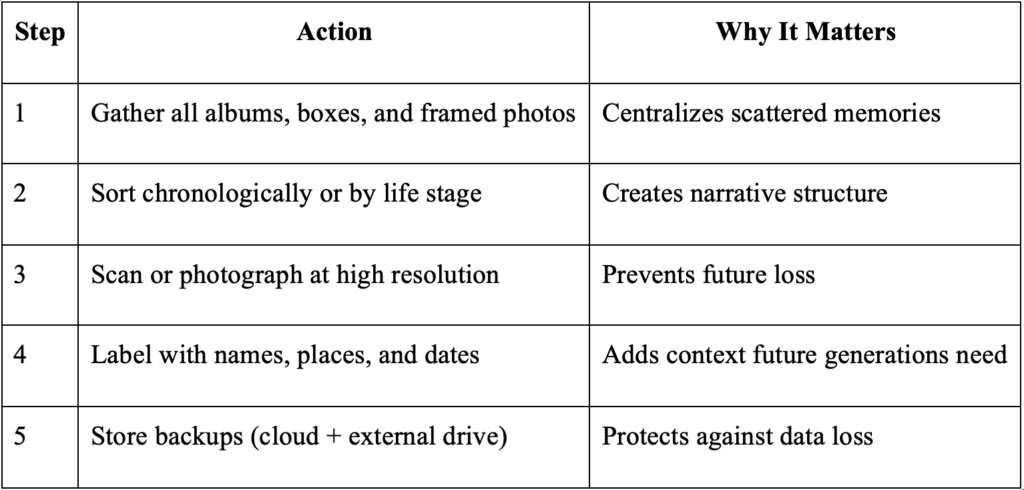
The labeling step is crucial. Sit with your parent while reviewing photos and ask: Who is this? Where was this taken? What was happening that day?
Without context, images become anonymous artifacts. With context, they become stories.
Capturing Recipes, Traditions, and Everyday Rituals
Family culture lives in small, repeatable acts: holiday meals, Sunday routines, bedtime sayings.
Ask your parent to:
- Write out (or dictate) their signature recipes.
- Explain how a holiday tradition began.
- Describe how celebrations changed over the decades.
- Share the meaning behind family heirlooms.
Record not just the instructions, but the memories attached to them. “This was your grandfather’s favorite cake” is as valuable as the ingredient list.
These small details often become the emotional centerpieces of family keepsake books.
Turning Memories Into Artful Keepsakes
Some of the most meaningful legacy projects families create involve bringing a parent’s earlier life to life visually — transforming a faded wedding photo into a beautifully framed portrait, reimagining a black-and-white snapshot in soft watercolor, or creating an artistic rendering of a beloved family moment for inclusion in a commemorative book. Tools like Adobe Firefly’s AI portrait generator have made it far more accessible to reinterpret cherished family photos in evocative artistic styles. Instead of commissioning a traditional artist, adult children can create deeply personal, one-of-a-kind visual tributes that honor their parent’s life in a tangible, display-worthy way.
These pieces often become conversation starters — and treasured heirlooms.
A Practical How-To: Creating a Life Story Project
Step-by-step approach for families:
- Choose a format. Audio archive? Printed memoir? Photo book? Mixed-media scrapbook?
- Set a rhythm. Schedule recurring sessions so it doesn’t stall.
- Prepare prompts in advance. Focus on life stages: childhood, early adulthood, parenthood, career, retirement.
- Record and transcribe. Even short sessions add up.
- Edit lightly — preserve voice. Don’t over-polish authenticity away.
- Share drafts. Invite your parent to clarify, expand, or correct.
- Create a final keepsake. Print copies for siblings and grandchildren.
Small, consistent effort beats a rushed, overwhelming push.
Frequently Asked Questions
How do we start if our parent says their life isn’t “interesting”?
Reassure them that ordinary experiences are exactly what future generations cherish. Focus on emotions, relationships, and daily life — not just milestones.
What if siblings disagree about how to approach the project?
Assign roles. One sibling handles interviews, another organizes photos, another designs the book. Clear division reduces friction.
Is it too late if memory issues have started?
Not necessarily. Shorter, focused sessions or just a brief, shared activity can still capture meaningful moments. Even fragments are valuable.
How long should this project take?
There’s no fixed timeline. Many families work over several months or a year, depending on depth.
A Helpful Resource for Family Historians
If you’re looking for clear, practical advice on how to interview family members and record their memories, the Oral History Resources page from the Society of American Archivists offers a suite of useful tools, guidelines, and tips for people new to oral history interviews — including suggestions on planning your project, choosing recording equipment, and preserving and sharing what you record.
The Unexpected Gift to Aging Parents
While families often begin these projects for future generations, many discover a powerful present-day benefit.
Aging parents frequently experience:
- Isolation after retirement.
- Loss of identity when roles shift.
- Reduced daily engagement.
Being asked to tell their story counters all three.
When you invite your parent to reflect, you signal: Your life matters. Your experiences shaped us. We want to understand you.
The process becomes:
- Meaningful daily engagement.
- Renewed sense of legacy.
- Deep connection time with the people who love them most.
That gift may be as important as the book or recording itself.
Preserving an aging parent’s life story is not about perfection or production value. It’s about presence. Start the conversations. Label the photos. Write down the recipes. Create something tangible.